


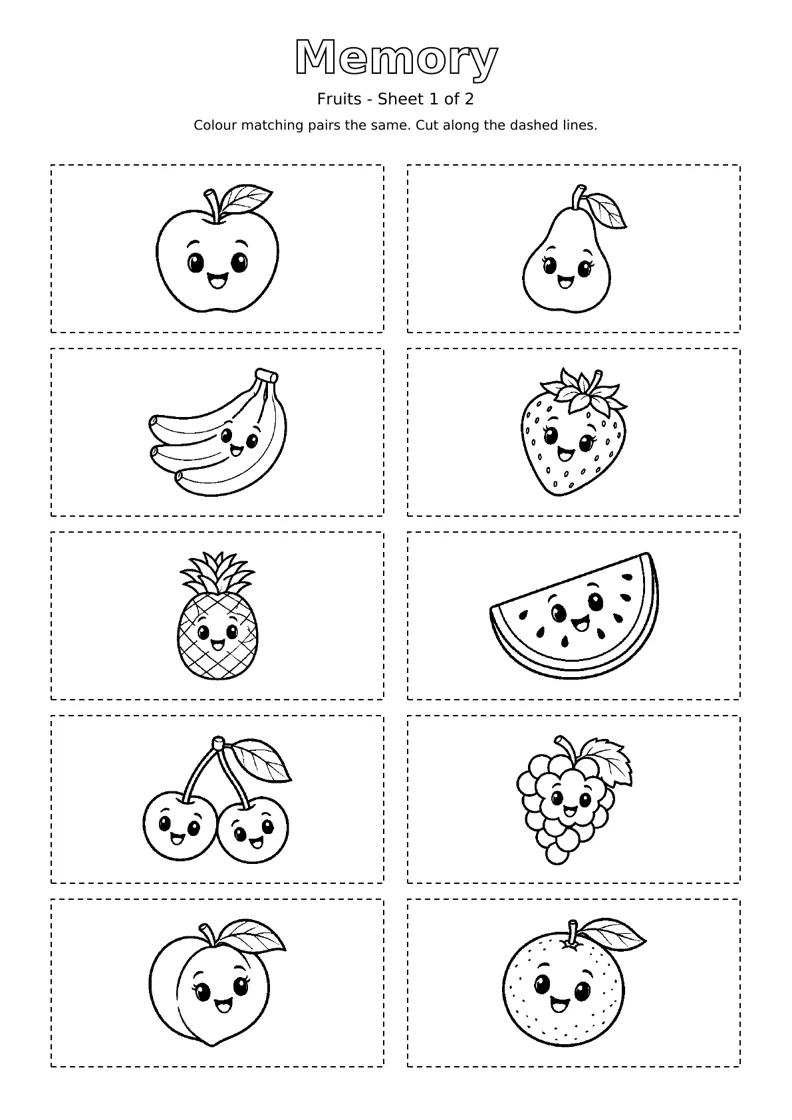
Your complete Memory game
One PDF contains both A4 sheets. Each sheet has 10 cards, with one copy of every picture. Print both pages once to make all 10 matching pairs.
↗ Open / Download 2-page PDFRead the game rules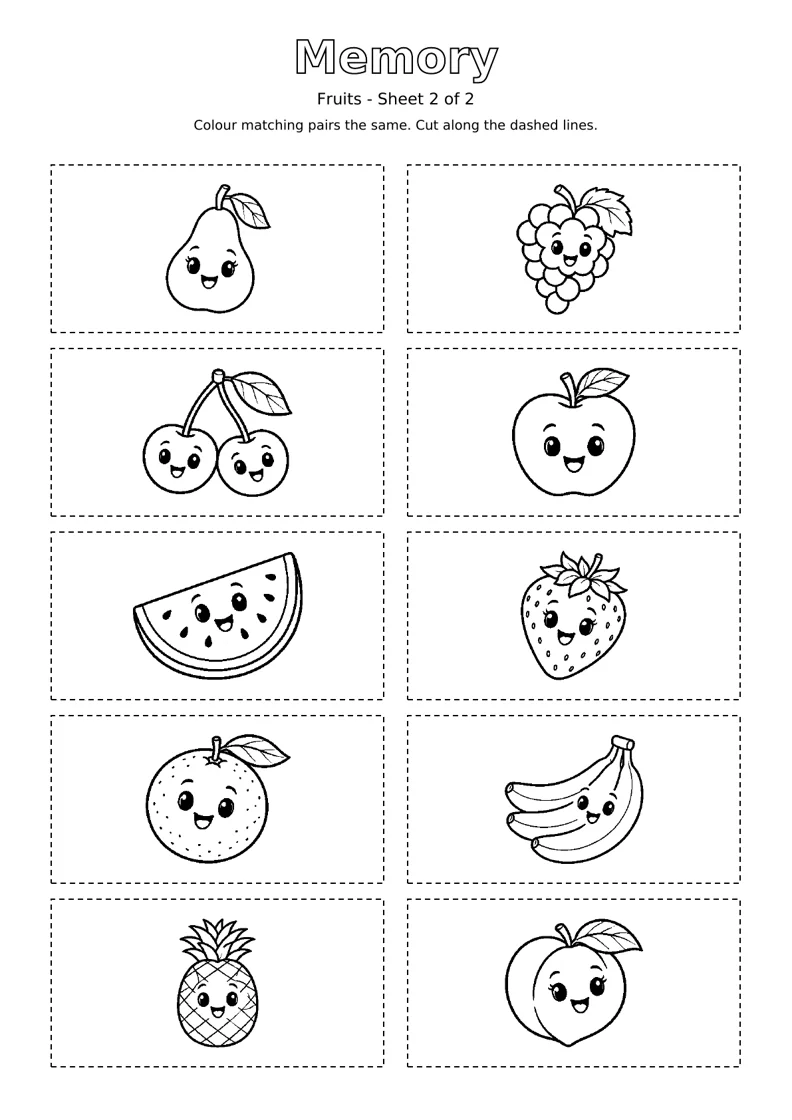
Make your cards: Print single-sided on thick, opaque paper or card. Choose A4 and “Actual size” / 100% for both pages so all cards have the same size. Colour matching pictures the same and cut along the dashed lines. Leave the backs blank. The previews above are the two pages of the same complete-game PDF.
Make a fruit matching game with your own colours
Fruits Memory offers a playful collection of ten fruit pictures to colour, cut and match. Apples, pears, bananas, strawberries, pineapple, watermelon, cherries, grapes, peach and orange appear across the set. Some drawings show a single fruit, while others show a bunch or pair as one complete illustration. Every picture is repeated exactly once, creating ten matching pairs for a twenty-card game.
Look at the outlines before adding colour. Compare round forms with longer shapes, notice leaves and stems, and find the distinctive details in a watermelon wedge or pineapple. Children can name a favourite fruit or describe the drawing when its English name is new. The small differences between pictures provide clues that can help players remember the cards during a round.
Prepare both copies of each picture with similar colours, then cut the cards from their dashed rectangles. Arrange them face down and use the Memory rules to take turns revealing two cards. Encourage everyone to look at each reveal, because a fruit that appears on another player's turn may become useful later. Return unmatched cards to their original positions and keep collected pairs together.
The complete game opens as a two-page A4 PDF, with ten cards on each sheet. Print both pages single-sided at the same scale on opaque paper or card. After playing, try sorting the visible cards by outline, chosen colour or a description suggested by the child. Store the full fruit set together so the next game begins with all twenty cards and every picture has its matching partner.
